Building AI-Powered Legal Workflows
Architecture, Agents, RAG, and Human-in-the-Loop

Legal AI is often presented as a chatbot problem.
Ask a model a legal question, receive an answer, and the job is done.
That approach misses the more interesting engineering problem.
Real legal workflows involve documents, databases, permissions, business rules, APIs, users, approvals, audit trails, and sensitive information.
If we want AI to participate in those workflows, we need to design an architecture around controlled execution, not just text generation.
The Basic Architecture
A production-oriented legal AI workflow can be represented as:
User/Input → Orchestrator → Retrieval → AI Processing → Validation → Human Approval → Action
Each layer has a different responsibility
Input layer
The system receives information through channels such as:
Web forms
Email
Document uploads
CRM records
Internal applications
API requests
Orchestration layer
The orchestrator determines what should happen next.
For example:
New inquiry
   ↓
Validate required fields
   ↓
Classify request
   ↓
Retrieve approved knowledge
   ↓
Generate structured summary
   ↓
Create task
   ↓
Human review
The orchestrator should not blindly allow the model to execute arbitrary actions.
Retrieval-Augmented Generation
Legal workflows often depend on organization-specific information.
A general-purpose language model does not automatically know the latest internal policies, approved templates, client records, or proprietary knowledge.
This is where Retrieval-Augmented Generation (RAG) becomes useful.
A simplified RAG workflow looks like:
User query
   ↓
Query processing
   ↓
Vector/keyword retrieval
   ↓
Relevant source documents
   ↓
Context construction
   ↓
LLM
   ↓
Structured response
The important engineering principle is that the model should be given access to approved context rather than being expected to invent the required information.
Document Processing Pipeline
Legal organizations often have large document collections.
A document-processing pipeline could look like:
The metadata layer can include fields such as:
Document upload
      ↓
File validation
      ↓
Text extraction / OCR
      ↓
Chunking
      ↓
Metadata extraction
      ↓
Embedding/indexing
      ↓
Searchable knowledge layer
Document type
Matter ID
Client ID
Creation date
Effective date
Access classification
Document status
This metadata becomes important when implementing authorization-aware retrieval.
Access Control Is Part of the AI Architecture
A common mistake is to build retrieval first and security later.
For legal applications, access control should be considered before information reaches the model.
For example:
User
 ↓
Authentication
 ↓
Authorization
 ↓
Allowed documents
 ↓
Retrieval
 ↓
LLM context
The model should not receive documents simply because they exist in the organization's knowledge base.
The retrieval layer should respect the user's permissions.
Structured Outputs Are Safer Than Free-Form Actions
When AI interacts with business systems, structured outputs are often preferable to unrestricted natural-language responses.
For example:
{
"request_type": "contract_review",
"priority": "high",
"requires_human_review": true,
"recommended_action": "assign_to_legal_team"
}
The application can validate this output before performing any action.
This creates a separation between:
AI reasoning/output
and
application-controlled execution
That distinction is important for reliability.
Designing AI Agents for Legal Workflows
An AI agent can be viewed as a system that combines:
A model Instructions Context Tools Memory/state Decision logic Execution capabilities
A simplified agent loop might be:
Goal
 ↓
Plan
 ↓
Select tool
 ↓
Execute
 ↓
Observe result
 ↓
Evaluate
 ↓
Continue / escalate
For legal systems, however, unrestricted agent loops are risky.
The agent should operate within explicit boundaries.
For example:
Agent
 ├── Read approved documents
 ├── Search internal knowledge
 ├── Create internal task
 ├── Prepare draft
 └── Request human approval

Agent cannot:
 ├── Provide final legal advice
 ├── Send unapproved legal communication
 ├── Modify restricted records
 └── Execute high-impact actions without approval
Human-in-the-Loop Architecture
Human review should be an explicit system state.
For example:
AI task
   ↓
Generate result
   ↓
Confidence/risk evaluation
   ↓
 ┌───────────────┐
 │               │
Low risk      High risk
 │               │
 ↓               ↓
Automated      Human review
action            ↓
              Approve / Reject
                   ↓
                 Action
The exact threshold depends on the workflow.
A document classification task may require less intervention than a client-facing legal recommendation.
Example: AI Legal Intake Agent
Consider a legal intake workflow.
Step 1: Receive inquiry
A user submits a form or sends a message.
Step 2: Extract information
The system identifies structured fields such as:
Name
Contact details
Matter category
Description
Relevant dates
Attached documents
Step 3: Classify
The AI assigns a predefined category.
Employment
Contract
Corporate
Compliance
Other
Step 4: Retrieve information
The system retrieves approved internal information relevant to the workflow.
Step 5: Create a summary
The model generates a structured internal summary.
Step 6: Route
The workflow assigns the matter to the appropriate team.
Step 7: Human review
A qualified professional reviews the information and determines the next action.
This is much more useful than simply deploying a chatbot that answers questions.
AI + Traditional Automation
Not every component needs an LLM.
A mature architecture may combine deterministic automation with AI.
For example:
AI:
Classification
Extraction
Summarization
Semantic retrieval
Traditional software:
Authentication
Permissions
Database writes
Notifications
Scheduling
Workflow state
Audit logging
This hybrid approach is often more predictable than asking an LLM to control everything.
Observability and Auditability
Legal AI systems should be observable.
Useful events to record can include:
User identity
Request ID
Model/version
Retrieved sources
Tool calls
Workflow state
Human approvals
Final action
Errors
A simplified audit trail could look like:
Request #1842
   ↓
Classification
   ↓
Retrieved documents
   ↓
AI-generated summary
   ↓
Human reviewer
   ↓
Approved
   ↓
CRM updated
This creates a record of what happened rather than treating the AI model as a black box.
Evaluating the System
Accuracy is only one metric.
A legal AI workflow should be evaluated across several dimensions:
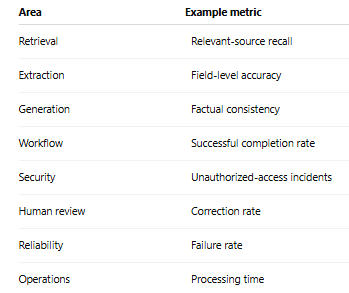
Evaluation should include difficult and adversarial cases, not only successful examples.
Common Architecture Mistakes
Giving the model unrestricted database access
Use application-controlled tools and permissions.
Treating RAG as automatically trustworthy
Retrieved documents still need source quality and access validation.
Allowing free-form tool execution
Use structured schemas and validation.
Removing human approval
High-impact legal workflows should define explicit human checkpoints.
Ignoring audit trails
AI actions should be observable.
Optimizing only for speed
A faster workflow that produces unreliable results is not a successful legal AI system.
Where AI Agents Make the Most Sense
AI agents are most compelling when the workflow contains multiple repetitive steps across different systems.
For example:
Email
 ↓
Extract information
 ↓
Classify request
 ↓
Search knowledge base
 ↓
Create CRM record
 ↓
Create task
 ↓
Notify team
 ↓
Request approval
This is fundamentally different from a chatbot answering:
“What is this policy about?”
The chatbot provides information.
The workflow agent can participate in the operational process.
A Practical Technology Stack
A legal AI platform can be assembled from multiple layers:
Frontend
React / Next.js
Secure authentication
Role-based interfaces
Backend
Node.js / Python
REST or GraphQL APIs
Workflow orchestration
AI layer
LLM
Embedding model
RAG pipeline
Structured output validation
Data
PostgreSQL
Vector database
Object storage
Metadata/indexing layer
Automation
Workflow engine
Event queues
API integrations
Security
RBAC
Encryption
Audit logs
Secrets management
Access policies
The exact stack depends on the organization's requirements.
The architecture matters more than choosing a fashionable framework.
The Engineering Principle
The most important design principle for legal AI is simple:
Don't give AI more authority than the workflow requires.
Use AI where probabilistic reasoning adds value.
Use deterministic software where deterministic behavior is required.
Use human review where professional judgment is required.
That creates a layered system:
AI intelligence
      +
Deterministic software
      +
Security controls
      +
Human judgment
      =
Responsible legal automation
Final Thoughts
Building AI for legal work is not primarily about connecting an LLM to a chat interface.
It is a systems-engineering problem.
The difficult parts include:
Secure data access
Retrieval
Workflow orchestration
Tool permissions
Structured outputs
Human approval
Evaluation
Observability
Auditability
Reliability
When these components are designed together, AI can become part of a legal team's operational infrastructure rather than another isolated productivity tool.
The goal should not be autonomous AI at any cost.
The goal should be controlled intelligence that makes legal professionals more efficient while preserving human responsibility.
Saawahi IT Solution works on custom AI applications, AI agents, generative AI systems, workflow automation, and software integrations for organizations exploring these kinds of intelligent workflows.
Original article: https://www.saawahiitsolution.com/insights/ai-powered-legal-work-lawyers/
This article is for general informational purposes and does not constitute legal advice


